
How to play Spoons
Spoons is a fast, frantic 3–6 player card game — everyone acts at once, no waiting your turn, until the whole table scrambles for a spoon. Here's exactly how it works, matching how Card Night deals and plays it.
The goal
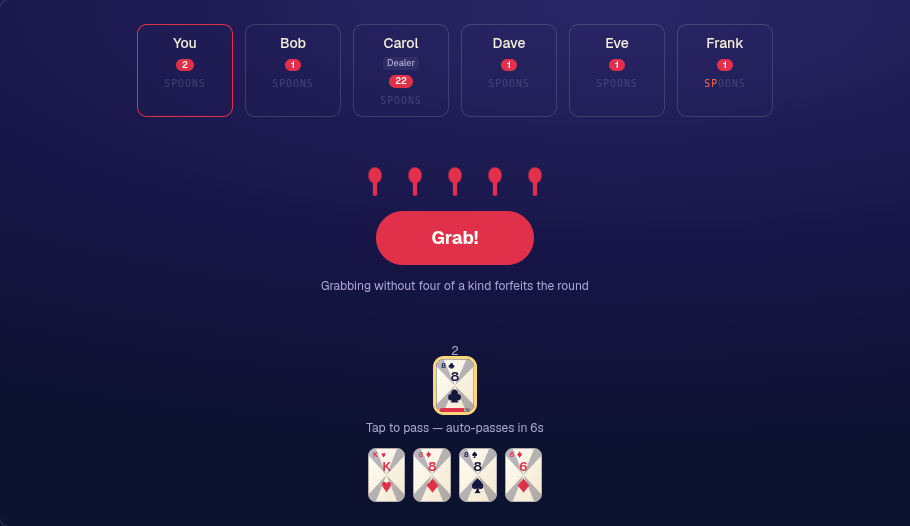
Collect four cards of the same rank in your hand, then grab a spoon from the middle of the table before everyone else does. There's always one fewer spoon than there are players, so exactly one person always misses out.
Setup
- One standard 52-card deck, no jokers, however many players you have (3 to 6).
- Each player is dealt a 4-card hand.
- The dealer starts the round holding the entire rest of the deck as their own incoming pile — there's no separate stock or draw pile.
- A shared tray in the middle holds one fewer spoon than there are players.
Card Night deals for you automatically. The dealer rotates to the next surviving player each round.
Passing and swapping
There are no turns — everyone acts at the same time, as fast as they want. In front of you sits one incoming card. You have two options:
- Tap the incoming card to pass it along unchanged — the fast default when you don't need it.
- Tap a card in your hand to swap it for the incoming card — your card goes into circulation, the incoming card joins your hand.
Every card you pass or swap goes to the player on your left, and the whole deck just keeps circulating that way — the last seat passes straight back around to the dealer, so nothing is ever discarded or reshuffled. If the player to your right is passing faster than you can keep up, cards pile up in front of you; you only ever see and act on the oldest one, and the pile's size (not its contents) is the only thing anyone else can see.
Sit on a card too long and a visible countdown ticks down on it — if you don't act, it passes along on its own so nobody can jam up the whole table by going AFK.
Grabbing a spoon
The instant you're holding four of a kind, grab a spoon. The moment anyone's first spoon is taken, passing and swapping freeze immediately for the whole table — every card stays exactly where it is — and it's a pure scramble for whoever's left standing to grab one of the remaining spoons before they're gone.
Bad grabs forfeit the round
You can actually grab a spoon at any time, not just once you genuinely have four of a kind — Card Night doesn't stop you. But grab without a real four of a kind and you forfeit the round on the spot, banner and all. It's a real bet: a bold early grab can steal a spoon before anyone else is ready, but guessing wrong costs you the round just as surely as being last.
Letters and elimination
Whoever's left without a spoon when the dust settles — by forfeit or by simply being too slow — gets the next letter of S-P-O-O-N-S. Spell the whole word and you're out of the match for good (you can keep watching, but you're done playing). Everyone else's letters carry over round to round, and the tray loses a spoon each time the table loses a player, so it's never a race against a spoon count that doesn't match who's left.
Ready-up between rounds
When a round ends, everyone sees a banner — congratulations if you got a spoon, commiseration (or a forfeit notice) if you didn't. The next hand doesn't deal until every surviving player taps Ready for next round, so nobody's outcome flashes by before they've even seen it.
Winning the match
Play continues, round after round, until exactly one player hasn't spelled S-P-O-O-N-S. That last player standing wins the whole match.
Tips
- Don't hoard a hand that isn't going anywhere. If your four cards are all different ranks, swap freely — sitting on a dead hand just means you're not building toward anything while everyone else is.
- Watch the table, not just your hand. A sudden freeze means somebody's already grabbed — react to the scramble, not to your own progress.
- A desperate grab is a real option, not a mistake. If the pile in front of you is stacking up and nobody's grabbed yet, a well-timed guess can steal a spoon outright — just know you're betting the round on it.
- Play it with 5 or 6 people if you can. More players means more cards circulating and more chances for someone else to build four of a kind before you notice — the bigger the table, the more frantic it gets.